The Song Hidden Inside the Song
Portions of this blog post relied on A.I. assistance. Turn on AI Lens to see where A.I. wrote, helped edit, or informed this post.
- A.I.-informedResearch or guidance; wording retained
- Reference
- Research
- Synthesis
- A.I.-assistedMy draft wording, edited with A.I.
- Mechanical
- Local wording
- Structure
- A.I.-writtenNew phrasing composed by A.I.
- Word or phrase
- Sentence
- Passage
How the levels are assigned
Each highlight is assigned from the saved draft and editing record.
A.I.-informed: A.I. supplied a source, research, or guidance used here, while the wording remained mine.
- 1. Reference: Located or inserted a source link, without extracting a fact or statistic for the passage.
- 2. Research: Extracted or checked a fact, statistic, or other specific information used in the passage.
- 3. Synthesis: Combined or compared source findings to supply a conclusion or guidance used in the passage.
A.I.-assisted: A.I. edited wording already in my draft: spelling, grammar, punctuation, emphasis, or requested phrasing polish.
- 1. Mechanical: Corrected spelling, grammar, punctuation, spacing, capitalization, or requested emphasis; no discretionary phrasing polish.
- 2. Local wording: Polished word choice, a phrase, or word order within an existing sentence, without reorganizing multiple sentences.
- 3. Structure: Reordered, combined, or recast multiple existing sentences or the organization of a paragraph; new standalone passages belong under written.
A.I.-written: A.I. composed a new phrase or passage for a placeholder, a request for new wording, or a replacement passage. My supplying the idea or approving the result does not change who composed the wording.
- 1. Word or phrase: Composed a new word, phrase, title, label, or caption fragment, rather than a complete sentence.
- 2. Sentence: Composed a complete sentence, or sentences within a larger author-written passage. A standalone sentence caption is included here.
- 3. Passage: Composed or replaced an entire prose paragraph or a larger passage, including a complete multi-sentence notice or footnote.
Research alone is informed. Editing my existing language raises it to assisted. Composing new phrasing raises it to written, even if it is just one word. Simply adding a link I supplied or putting my words into a widget does not establish an A.I. contribution to the wording.
Highlights cover the affected punctuation, word, or phrase, not the surrounding unchanged sentence. A small raised minus (−) marks a deletion. Pause over a highlight to see its category, sublevel, and recorded edit in a margin annotation. The side follows where you first paused and stays put until the annotation closes. Narrow windows use a footnote-style popup. You can also focus a highlight with the keyboard or tap it; Escape or a tap outside closes the annotation.
Sublevels follow the specific action or extent described above. They are measured within each category: written 1 still means new A.I. wording, whereas assisted 3 means editing my existing language. Mixed contributions are split where possible; an inseparable unit uses the highest category and sublevel supported by its record. A highlight does not assign ownership of my ideas to A.I.
These labels cover the recorded editing session. Unhighlighted text makes no claim about earlier A.I. involvement. Colors are contribution categories, not percentages or detector scores.
Day 3 of my 100 days of writing. Once again, I have to remind myself every time: the goal is to write, not to write well. I’ve rewritten the first sentence about ten times, and it’s late and I’m tired.
Take a look at the classic GIF below. In which direction is the woman spinning? Left to right, or right to left? Can you make yourself perceive her spinning in the other direction?
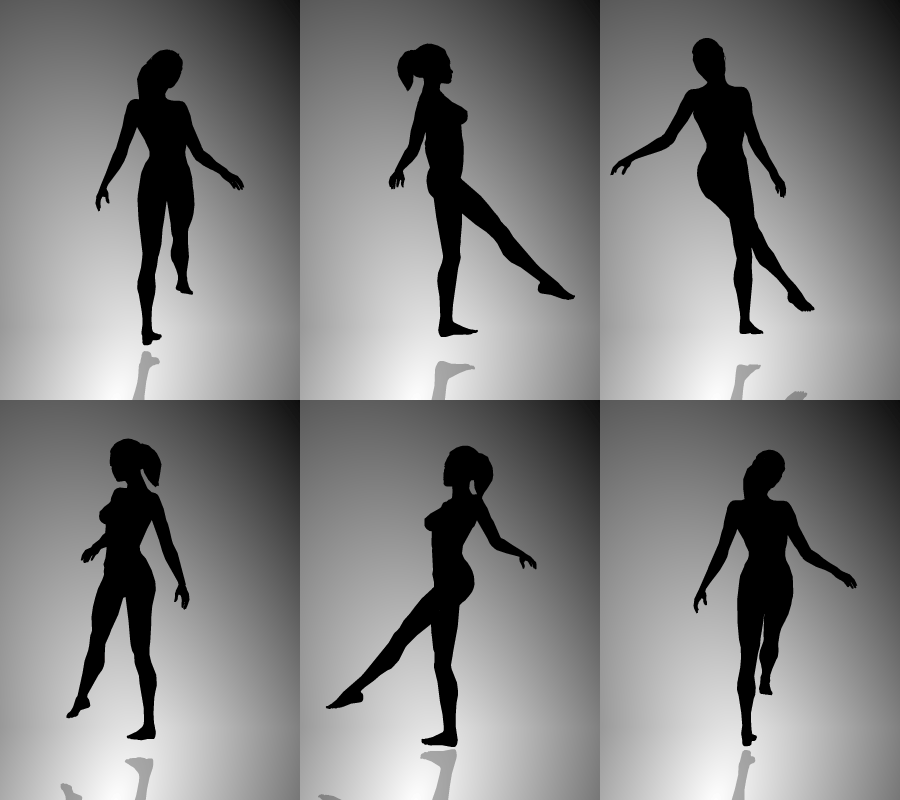
The Spinning Dancer · Nobuyuki Kayahara · CC BY-SA 3.0

This very famous optical illusion demonstrates how certain sensory contexts can trick our brain into perceiving reality differently.
Well, today I want to talk about one of these kinds of illusions, but in the auditory realm.
After 15 years of listening to Radiohead’s song, Little By Little, I’ve finally done it. I can will myself to hear both versions of the song. Like the spinning lady, this song can also be perceived in two ways.
Radiohead’s frontman, Thom Yorke, has a fascinating tendency to play with perception in his music. He oft creates music with purposefully ambiguous meters.
“Meters? What?” I hear you say.
Ok, so in music, a meter is basically the beat of the song—the recurring pattern of pulses that your head bobs to when listening to a song, that “1, 2, 3, 4” that you naturally feel pulsating from the music. For 99.9% of all songs, this “1, 2, 3, 4” is so deeply ingrained into the music that there is no question about when the beat is happening—you feel it and know it naturally, even if you know nothing about music theory. It’s impossible not to notice the meter.
And then there’s Thom. By carefully crafting unusual arrangements of melodies and rhythms, Thom creates remarkable auditory illusions: songs where different people will feel the meter differently.
It turns this track (and others, like The Eraser, Cymbal Rush, and Videotape) into an interesting auditory Magic Eye phenomenon. Hidden within the song is a different song. You can train your ear to hear the meter in a subtly different way that alters how the entire musical arrangement feels to your mind and body.
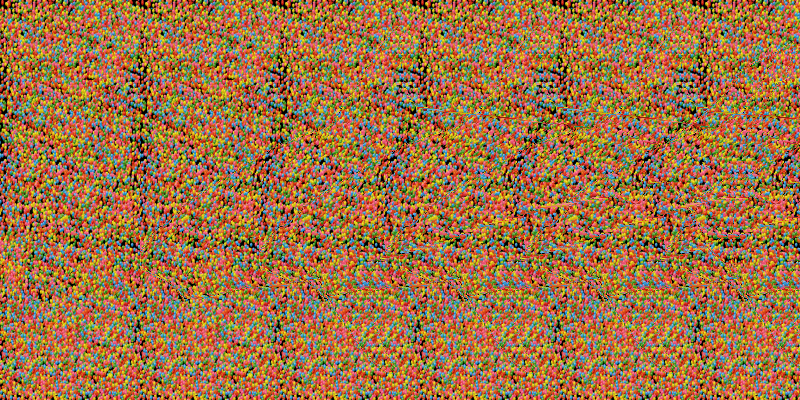
Magic Eye-style autostereogram · Fred Hsu · CC BY-SA 3.0

In my 30 years, I have never accomplished seeing the hidden image in a single Magic Eye image, so as much as people describe to me what I’m supposed to see past the visual melee, I have no idea what they’re talking about. Well, in that same way, I don’t think I can explain to you what it feels like to hear Thom’s music when you tap into the hidden meter.
This fascinating trick of rhythm keeps me coming back to his music time and time again. Quite literally, I can come back to his music and find something new in it, and hear a song I’ve always loved in a new form, as if listening to it for the first time.
I cannot describe it to you. Not tonight, at least. But it’s there. I just wanted to share that I’ve accomplished the feat. And I hope you can one day too.
Now, maybe one day I’ll be able to see the hidden image in a Magic Eye.
What in your life could you benefit from perceiving in a new way?