Did the New York Times use A.I.-generated voices on The Daily podcast?
The Daily’s October 5th podcast sounds highly unusual at times. While it’s probably not a case of A.I.-generated voice use, the uncertainty alone has something to teach us about our current moment in history.
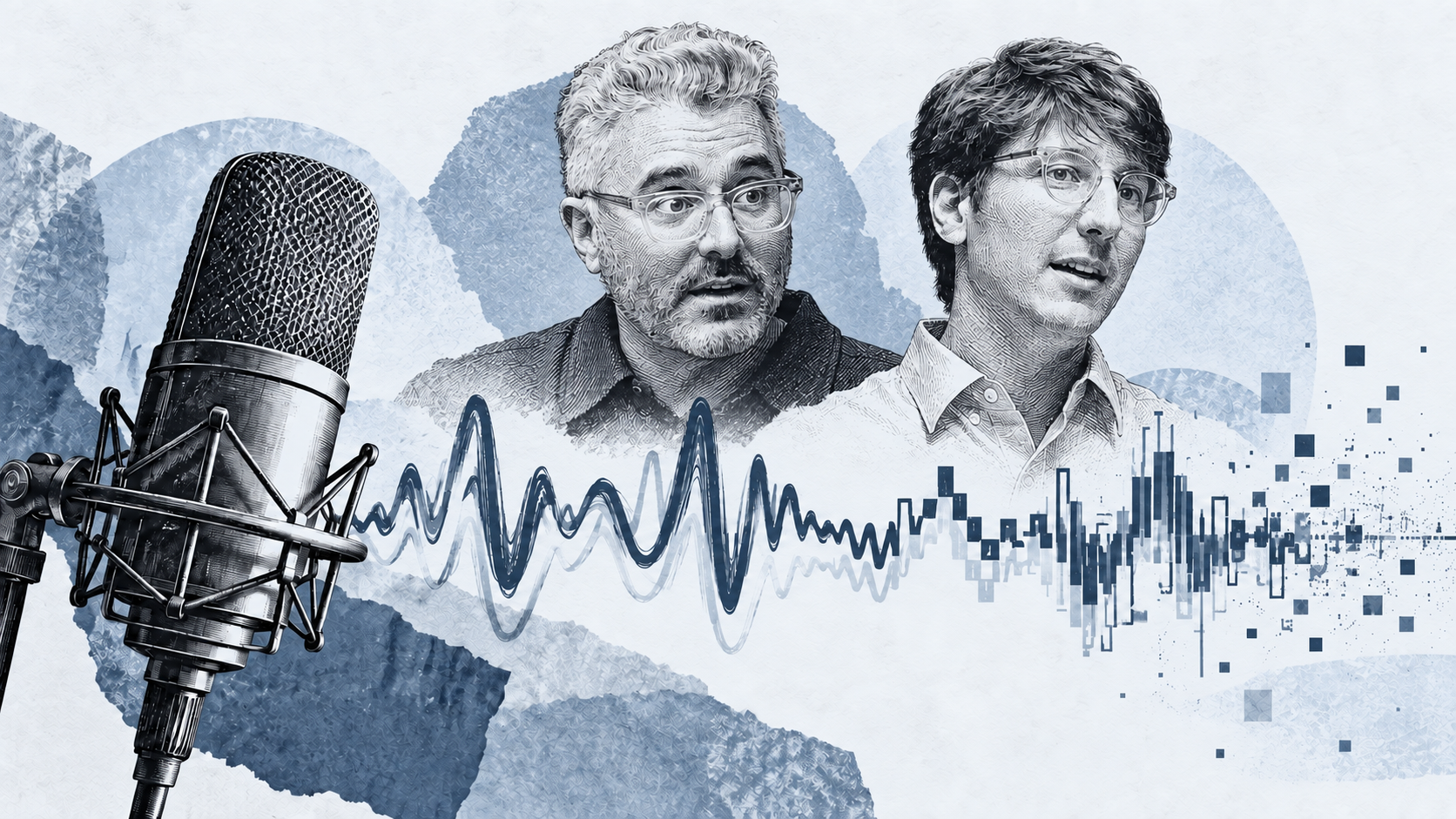
A.I.-generated image. In the October 5, 2026 episode of The Daily, Michael Barbaro (left) and Nate Cohn (right) exchanged some unusual dialogue. Was it A.I.? Or is it just impossible to tell reality apart from A.I. anymore?
Portions of this blog post relied on A.I. assistance. Turn on AI Lens to see where A.I. wrote, helped edit, or informed this post.
- A.I.-informedResearch or guidance; wording retained
- Reference
- Research
- Synthesis
- A.I.-assistedMy draft wording, edited with A.I.
- Mechanical
- Local wording
- Structure
- A.I.-writtenNew phrasing composed by A.I.
- Word or phrase
- Sentence
- Passage
How the levels are assigned
Each highlight is assigned from the saved draft and editing record.
A.I.-informed: A.I. supplied a source, research, or guidance used here, while the wording remained mine.
- 1. Reference: Located or inserted a source link, without extracting a fact or statistic for the passage.
- 2. Research: Extracted or checked a fact, statistic, or other specific information used in the passage.
- 3. Synthesis: Combined or compared source findings to supply a conclusion or guidance used in the passage.
A.I.-assisted: A.I. edited wording already in my draft: spelling, grammar, punctuation, emphasis, or requested phrasing polish.
- 1. Mechanical: Corrected spelling, grammar, punctuation, spacing, capitalization, or requested emphasis; no discretionary phrasing polish.
- 2. Local wording: Polished word choice, a phrase, or word order within an existing sentence, without reorganizing multiple sentences.
- 3. Structure: Reordered, combined, or recast multiple existing sentences or the organization of a paragraph; new standalone passages belong under written.
A.I.-written: A.I. composed a new phrase or passage for a placeholder, a request for new wording, or a replacement passage. My supplying the idea or approving the result does not change who composed the wording.
- 1. Word or phrase: Composed a new word, phrase, title, label, or caption fragment, rather than a complete sentence.
- 2. Sentence: Composed a complete sentence, or sentences within a larger author-written passage. A standalone sentence caption is included here.
- 3. Passage: Composed or replaced an entire prose paragraph or a larger passage, including a complete multi-sentence notice or footnote.
Research alone is informed. Editing my existing language raises it to assisted. Composing new phrasing raises it to written, even if it is just one word. Simply adding a link I supplied or putting my words into a widget does not establish an A.I. contribution to the wording.
Highlights cover the affected punctuation, word, or phrase, not the surrounding unchanged sentence. A small raised minus (−) marks a deletion. Pause over a highlight to see its category, sublevel, and recorded edit in a margin annotation. The side follows where you first paused and stays put until the annotation closes. Narrow windows use a footnote-style popup. You can also focus a highlight with the keyboard or tap it; Escape or a tap outside closes the annotation.
Sublevels follow the specific action or extent described above. They are measured within each category: written 1 still means new A.I. wording, whereas assisted 3 means editing my existing language. Mixed contributions are split where possible; an inseparable unit uses the highest category and sublevel supported by its record. A highlight does not assign ownership of my ideas to A.I.
These labels cover the recorded editing session. Unhighlighted text makes no claim about earlier A.I. involvement. Colors are contribution categories, not percentages or detector scores.
So I started listening to today’s episode of The Daily, a chart-topping
I rewound to the beginning of the interview. Listen to it for yourself:
Podcast excerpts and screenshots are reproduced for criticism and commentary under a claim of fair use. Rights remain with their respective owners. Listen to the full episode for context.
Does anyone else find Nate’s and Michael’s tone and cadence very strange there? The pauses between words, just slightly off? Michael’s “And back so soon!” uncannily enthusiastic?
Uh. Is it me? Or was that A.I.?
Here’s another excerpt:
This one sounds a lot more natural, but Nate’s cadence, particularly when he says “in 2024,” still gives the sense that we’re not out of the uncanny valley. Someone cooked here, and it smells like shit fishy.
One more piece of evidence: I’m not the only one to point out that something’s off. In the YouTube, NYTimes.com, and Reddit comments, others expressed their suspicions as well—and apparently, listeners have been wondering this very question for months now.
Reader reactions
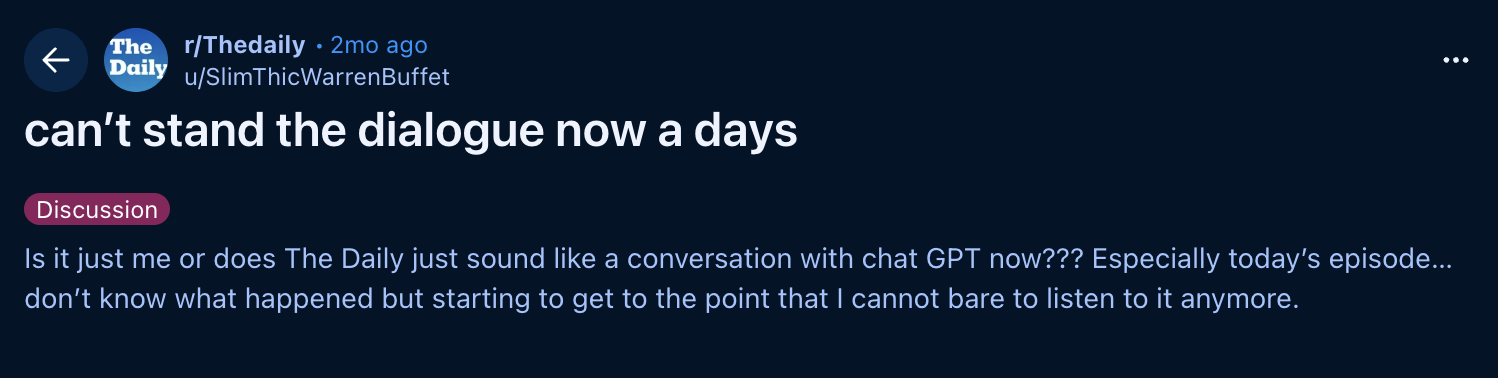
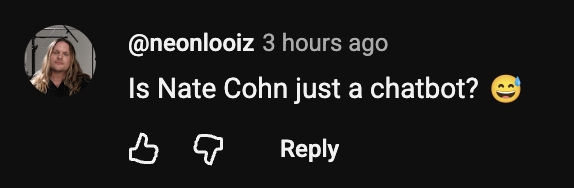

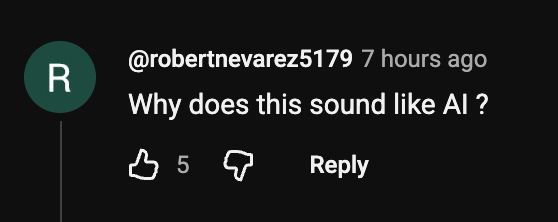
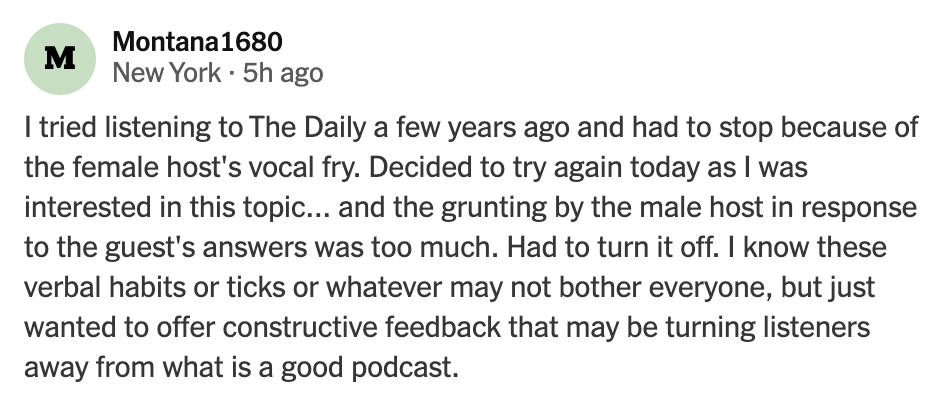
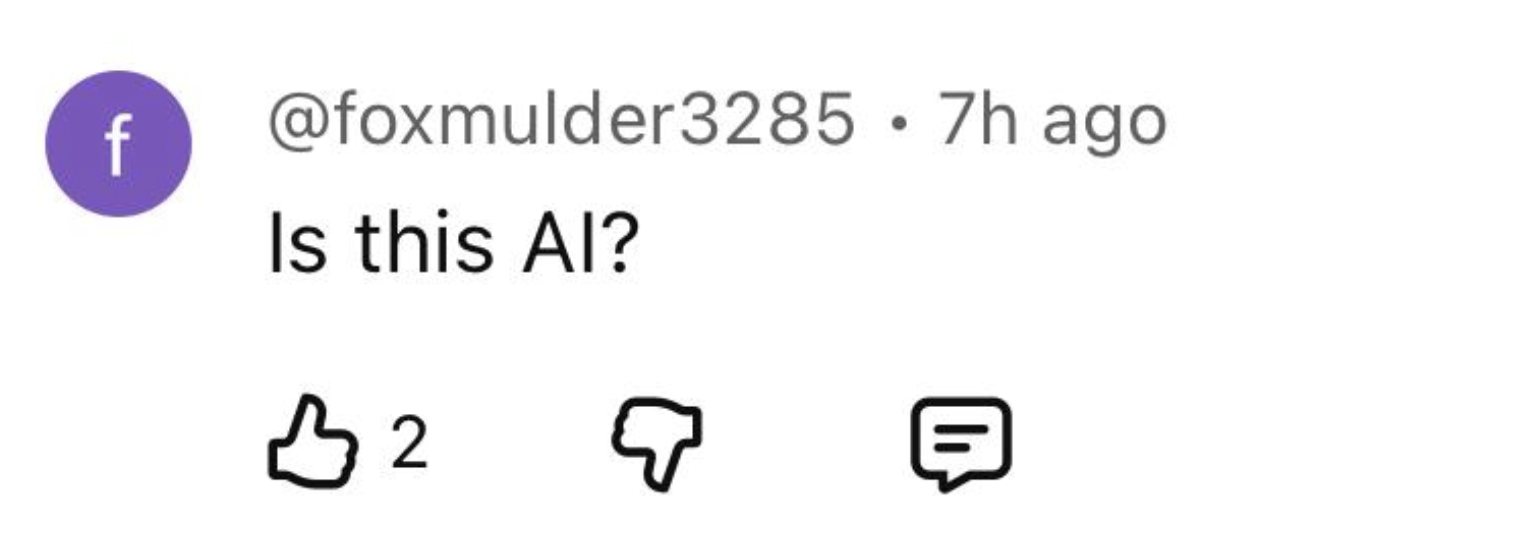
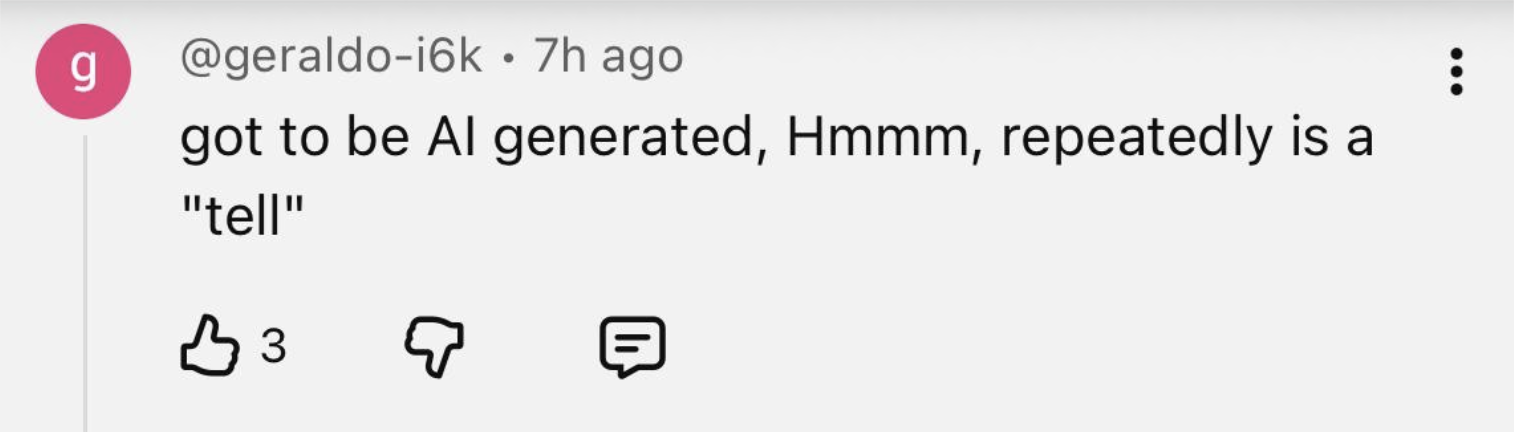
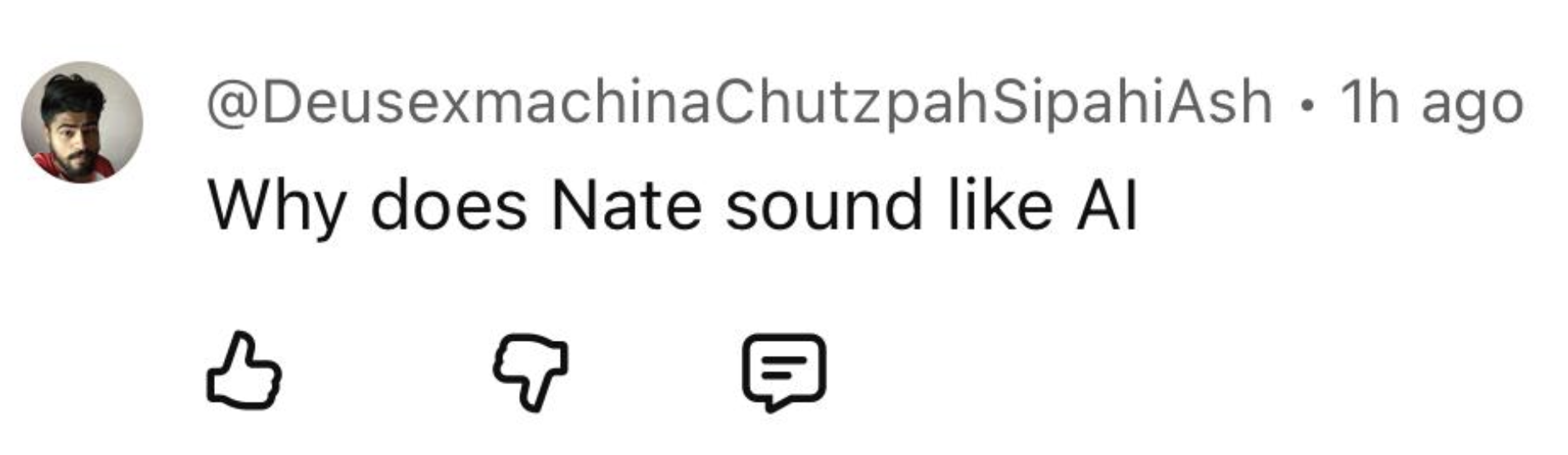
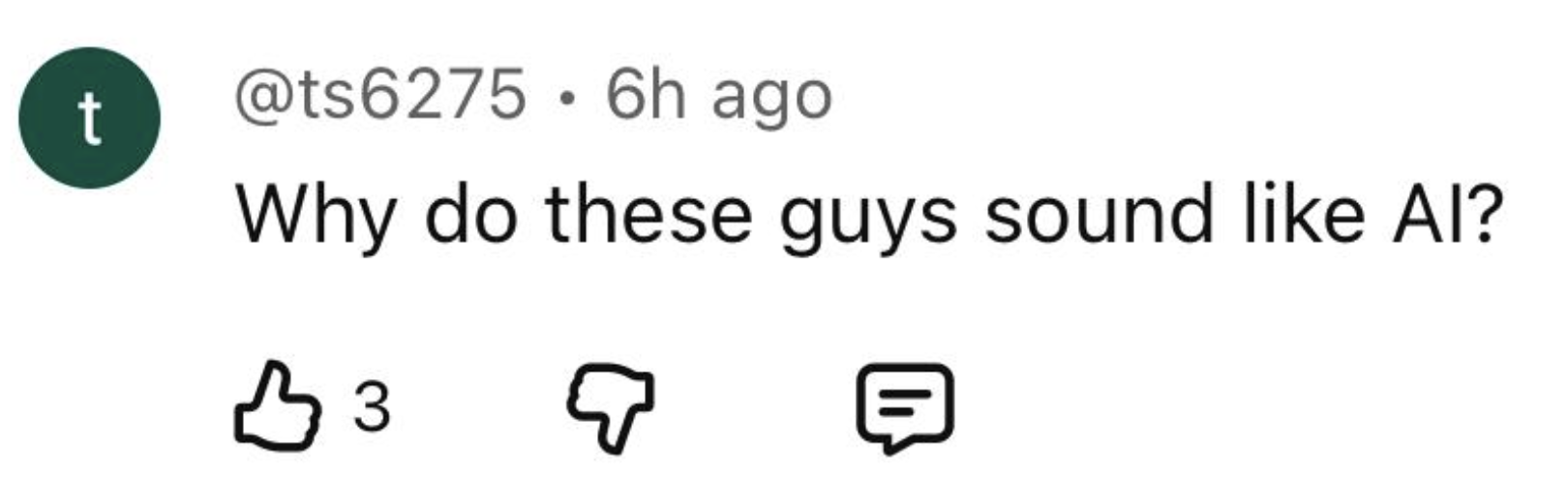
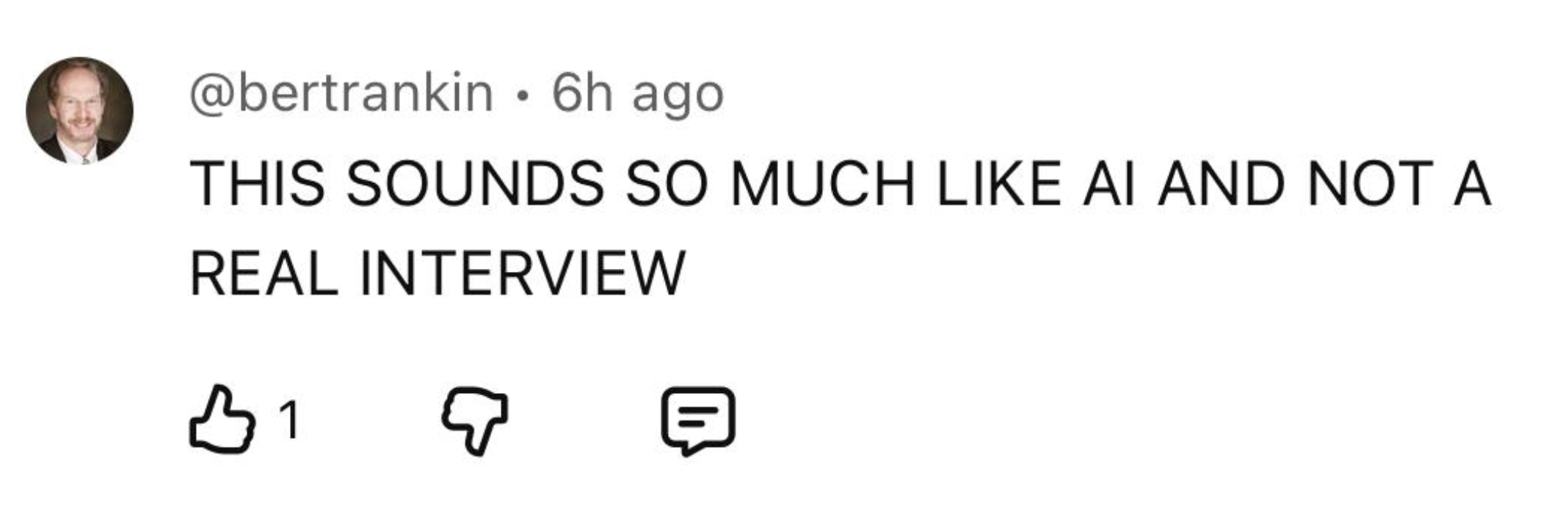
Select a screenshot to see it full-size.
Telling A.I. apart from reality is becoming harder and harder
If you think A.I.-generated voices couldn’t possibly be so natural-sounding, well, do I have news for you, buddy! The internet is now completely flooded with very convincing A.I.-generated audio and video, and it’s been very easy to deepfake someone else for a while now.
I myself use A.I. extensively.
Put your ears to the test
Which voice is mine?
One is me. One is an A.I. clone. Listen to both, then pick the synthetic voice.
Listen to both voices before choosing.
Reveal which voice is A.I.
Voice A is the A.I. clone. Voice B is my real recording.
If you’re thinking, “Well, of course I can’t tell your real voice from an A.I. clone. I don’t know you,” well, sure, but you should know that my own wife got it wrong too, and we talk to each other every other week at least.
Did the New York Times really use A.I. without disclosing it?
So despite the mostly natural-sounding audio in today’s podcast, it is very possible that it was generated by A.I., and the clips strongly suggest it, in my personal opinion.
But this would be explosive if true. The New York Times, one of the most serious journalistic institutions in the world, a company whose publicly available A.I. use principles state, “We should tell readers how our work was created,” using automated A.I. voices for its most popular podcast, without disclosing it?
It just can’t be.
So take your pick now: do you think it’s A.I.?
Your call
And the answer is…
I don’t know, man. I really don’t know.
It’s (probably) not A.I.!… but we can’t know for certain. But it certainly feels like A.I., doesn’t it? It must be!
I don’t know, man. I really don’t know.
The argument for why it’s not A.I.
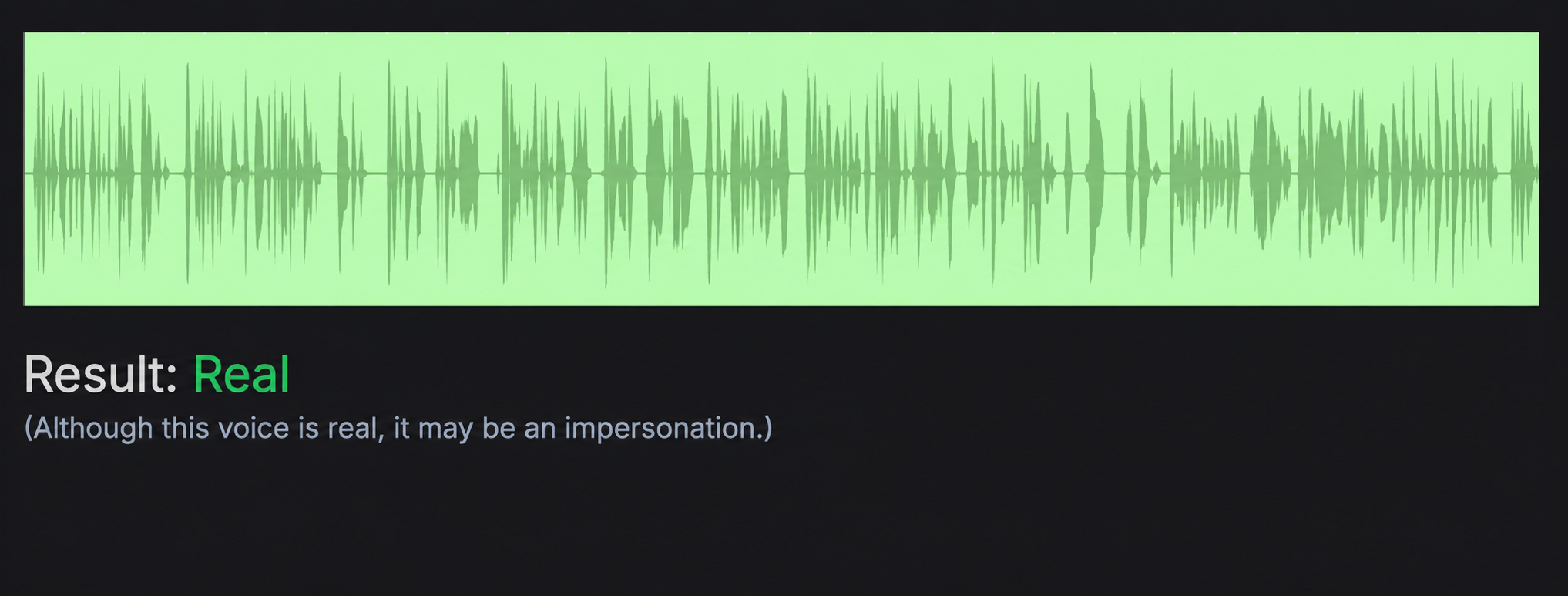
#1 AI Detection Tools Think It’s Real
Resemble AI’s free Audio Deepfake Detector assessed it as real. They claim to be able to detect AI voices from many different providers, and I did validate for myself that they indeed detect AI audio by giving it the same real-versus-fake J.I. voice test that you just took.
#2 It’s Against Their Own Policy
And then there’s the New York Times’ aforementioned AI use principles and the potential consequences of violating them. The real scandal wouldn’t be that they used A.I.; it would be that they did not disclose it.
If it were true, the blowback—the impact on their credibility and reputation among their readership and the journalistic community—could be enormous, though not necessarily likely. Lord knows many institutions unfortunately get away with contemptible use of A.I. due to a public that has fallen asleep at the wheel. But for an institution like the NYT, there is enough potential risk to their reputation that I just cannot fathom how an episode of The Daily, a chart-topping U.S. news podcast, could have reached publication with undisclosed use of AI. Surely, red flags would have been raised at every step of the editorial process.
#3 There is another plausible explanation
One theory is that the clumsy voicing in the clips I showed you is actually a byproduct not of A.I. voices, but of clumsy and perhaps A.I.-assisted editing. If you’ve ever used a podcast app with a “silence trimming” or “smart speed” feature, then you may know what I’m getting at. It’s plausible that some auto-edit tool employed during a hasty podcast production cycle (which is conceivable for a near-daily podcast) could have chopped up the audio to oblivion, thus totally throwing off the rhythm of a previously natural recording.
The dangers of false positives
The lesson here is that as A.I. improves, we won’t just mistake synthetic content for the real thing; we’ll also mistake the real thing for synthetic content. We’ve talked a lot about the danger of convincing fakes. We’ve talked much less about false positives: suspecting A.I. where there is none.In the coming years, don’t only anticipate that conmen and authoritarians will use A.I. to deceive the public. Anticipate that they will also deny reality and get away with it. If the unbelievable one day does happen—if an alien escapes Area 51, if the mythic Trump Pee Tape leaks on the internet, if someone successfully documents how many licks it takes to get to the center of a Tootsie Pop, or anything of the sort—expect the powers that be to do their damndest to dupe the public into believing that what was truly real was not. By then, not only will they have denied reality, but they will have—to an extent—controlled it. Let’s hope we still have institutions with integrity left when that day comes. I’d like to count on the New York Times to be among those. But these days, who’s to say?
Footnotes
Podfollow’s chart snapshot dated October 6, 2026 lists The Daily at No. 1 on Apple Podcasts’ U.S. All Podcasts chart and No. 7 on Spotify’s U.S. All Podcasts chart, and No. 1 in News on both. These are U.S. platform rankings, not a single worldwide ranking. Checked while editing this October 5 post. ↩
To my peers who very strongly oppose A.I. use of any form and are critical of others who do use it: I see and hear you, I share many of your beliefs, and I am largely supportive of your goals. But the morality of A.I. use and why I choose to use it is a topic for another blog post. ↩
Just kidding, honey. Love you. ↩